Rummy Practice Note 176: A Structured ReviewRummy Comparison: Defensive Discards Versus Productive Discards
Every discard has two possible jobs. A defensive discard tries to avoid giving an opponent a useful card. A productive discard improves your own hand by removing a weak card, clarifying a route, or lowering points. The best choice often performs both jobs, but when it cannot, you need a deliberate comparison.
Begin with your own hand. Ask whether keeping the card supports a valid sequence, a likely set, or a flexible repair. If it has no strong role, it is a productive candidate for release. Next, inspect what the table may gain from it. A card beside several visible cards could complete an opponent’s route, while an isolated card may be less immediately useful. This second step estimates risk without pretending to know another player’s hand.
Defensive play is attractive when an opponent appears close to a declaration or when the format makes a large penalty especially costly. However, excessive defense can freeze your own hand. Holding every card that might help someone else leaves fewer opportunities for your own improvement and may increase the cost of an eventual loss. Defensive choices should have a reason and a time limit.
Productive play is attractive when your hand has a clear route and you need to reduce clutter. It can be correct to release a card that an opponent might want if the discard completes your pure sequence or removes a high-value orphan. The key is to compare the size of your improvement with the opponent risk, not to avoid all informative cards.
Use a quick matrix: own improvement high or low, opponent risk high or low. High improvement with low risk is easy. Low improvement with high risk is usually poor. The difficult cases are high-high and low-low. In a high-high case, consider the score, the opponent’s apparent urgency, and whether another card can perform the same job. In a low-low case, prefer the card that keeps more future routes open.
Review your choices after the hand without judging only by what the opponent happened to draw. Ask whether the risk was visible at the time and whether your own improvement was real. This develops better judgment than calling every successful defense brilliant. A balanced discard protects your position while still moving the hand toward a legal finish.
The balance can change from turn to turn. Early in a hand, productive improvement may deserve priority. Later, when an opponent appears close, a defensive tie-breaker may matter more. Reassess instead of adopting one permanent rule.
Related Post
Rummy Comparison: Drawing From the Deck or Taking the Pile
Compare the privacy of a deck draw with the information cost and possible precision of [...]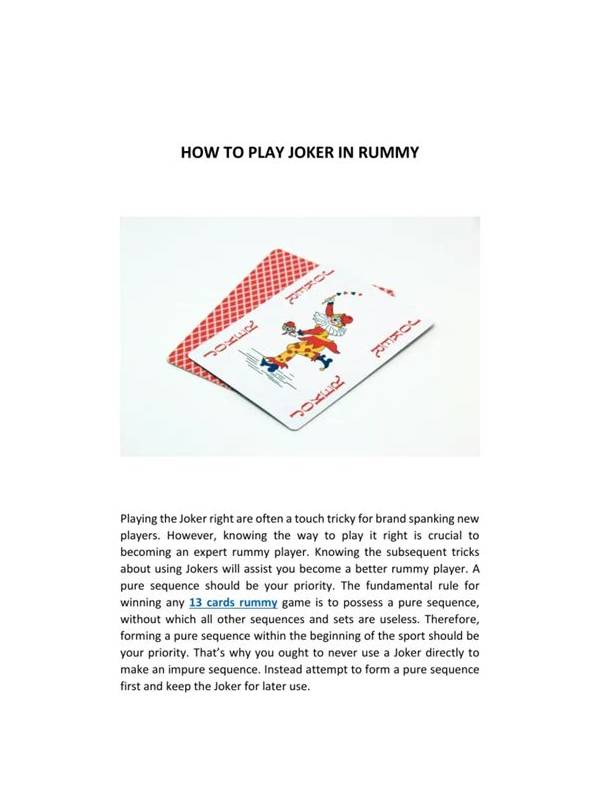
Rummy Guide: Give Every Joker a Specific Assignment
Assign a joker to the hardest-to-replace role so its flexibility creates reliable structure rather than [...]