Rummy Strategy: Read Pickup Signals Without Overreading Them

In an online rummy round, a card taken from the open pile can attract more attention than it deserves. It is visible information, so players often build a complete story around it: the opponent must be collecting that suit, finishing a set, or setting a trap. A better approach is to treat the pickup as a signal with limited strength. It can update your plan, but it should not replace the evidence in your own hand.
Start by recording the card that was taken and the position of the player who took it. A single pickup tells you only that the card had some value to that player at that moment. It does not tell you whether the card immediately completed a group. They may have taken it to preserve an option, to prevent another player from seeing it, or simply because the closed draw looked less useful.
Next, look for a second related signal. A later discard from the same suit may weaken the original theory. Two pickups that share a suit or rank are more informative, but even that pattern is not proof. Players can change plans after every draw. Your goal is not to guess their exact melds; it is to avoid handing them an obviously useful card when an equally good alternative is available.
Use the signal in three practical ways. First, compare candidate discards and remove cards that obviously extend the pattern you have observed. Second, reconsider taking a card from the open pile if it would reveal your own intention while helping theirs. Third, check whether your hand can finish safely without reacting at all. Often the strongest response is simply keeping your points low and your groups flexible.
Avoid common overreactions. Do not break a completed sequence because one opponent collected a nearby card. Do not discard a high-value card automatically if it is the only card that supports two plans. Do not assume a player has a card merely because its neighbor appeared in the pile. These choices sacrifice your structure for an uncertain narrative.
At the end of the round, review whether the signal actually improved your decision. Mark the pickup, your response, and what later information proved or disproved your assumption. With practice, you will learn to notice table information without allowing it to create unnecessary fear. The best read is usually a measured adjustment, not a dramatic change of plan.
Related Post
Rummy Comparison: Planned Risk Versus Accidental Risk
Planned risk has a defined reason and exit, while accidental risk grows when a player [...]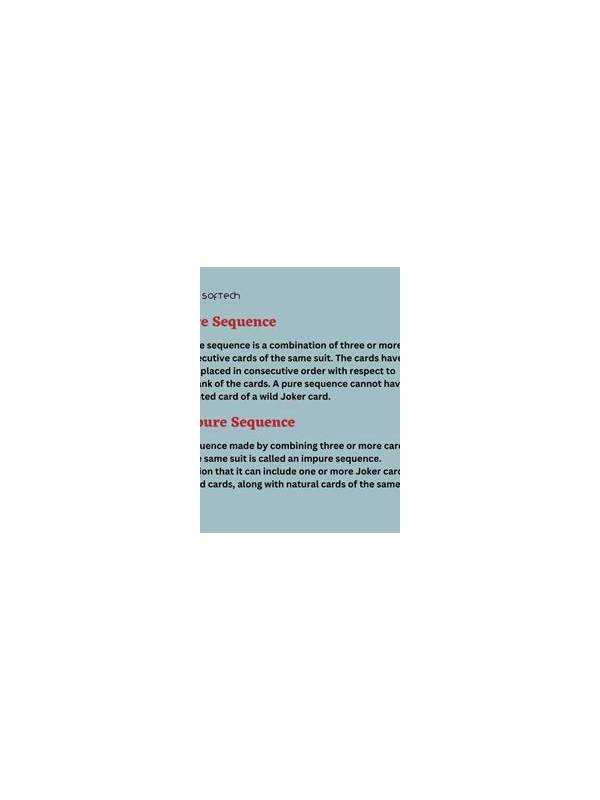
Rummy FAQ: What Is an Impure Sequence?
An impure sequence uses a joker to stand in for a missing card, subject to [...]