Rummy Guide: Turn a Loose Hand Into a Small Set of Choices
A useful discipline is to explain each route in terms of cards needed and cards at risk. This is clearer than saying that a hand “looks good.” Keep the menu temporary: a new draw may promote the backup route, while a miss may make the primary route too narrow. The goal is a clear next decision, not a permanent label for the hand.
An untidy rummy hand can feel difficult because every card appears to suggest a different future. One pair points toward a set, two connected cards suggest a sequence, and a high singleton demands attention because of its penalty value. The useful response is not to invent a perfect plan immediately. It is to reduce the hand to a few realistic choices.
Start by sorting the cards by suit and rank. Then mark only the strongest relationships: completed groups, adjacent cards, pairs, and cards that connect to more than one possible sequence. Ignore remote possibilities for the moment. A card that needs two specific unseen cards is a possibility, not yet a plan.
Next, describe three candidate routes in plain language. One route might preserve a nearly complete sequence. Another might use a pair to build a set. The third can be a safety route that discards the most expensive isolated cards while waiting for better information. Writing the routes mentally takes only a few seconds, but it prevents one attractive pair from controlling the entire hand.
Compare routes by completion distance. Count the missing cards, then consider how many cards would become awkward if the draw does not arrive. A route needing one card may still be fragile if that card has very few copies left. A route needing two cards may be healthier if it leaves several flexible connectors in place. The aim is not exact probability; it is a clear comparison of repair effort and downside.
Before discarding, choose a primary route and a backup condition. For example, keep the connected middle cards while one more draw supports them; if the next draw misses and leaves a high singleton untouched, switch to the backup. This expiration point keeps you from defending an old idea after the hand has changed.
Finally, review what the discard reveals. Taking or avoiding an open-pile card may give other players information, so do not chase a route only because it is visible. A small menu of choices makes decisions calmer, protects flexibility, and gives every later draw a clear question to answer. This method is useful when teaching too: describe cards needed and cards at risk, not whether a hand merely looks good.
Related Post
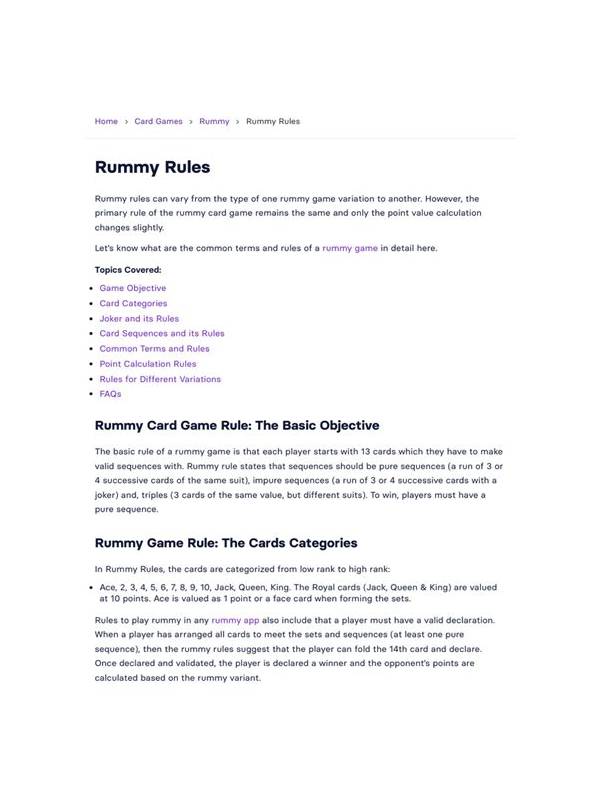
Rummy Comparison: Local Rules and Platform Rules
Separating familiar home rules from a platform’s written rules prevents avoidable disputes and failed declarations. [...]
Rummy Guide: Track Missing Cards Without Overcounting
A practical way to track useful missing cards while keeping your rummy decisions simple and [...]