Rummy Guide: Read Opponent Discards Without Guessing
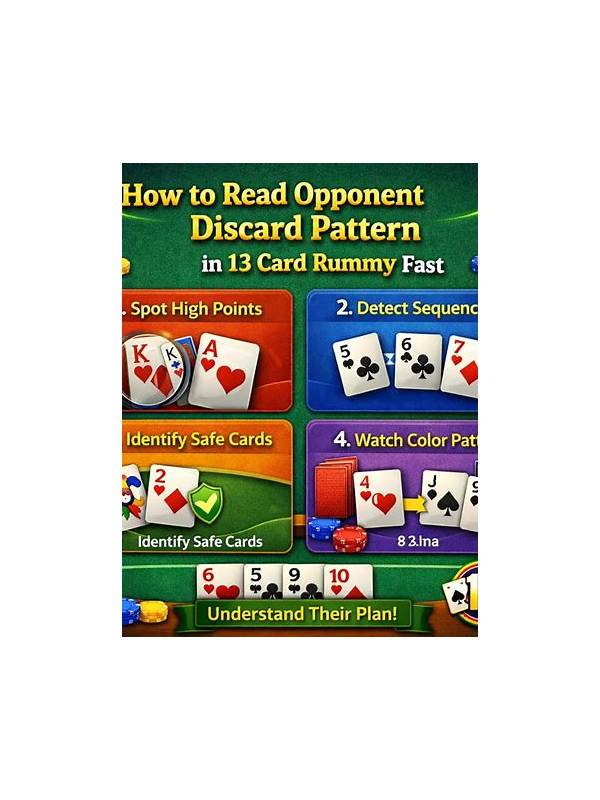
An opponent’s discard can be useful information, but it is not a complete explanation of their hand. A card may be unwanted, temporarily inconvenient, or simply the least useful choice on that turn. Treating every discard as a confession leads to narrow decisions. A better approach is to observe patterns and keep several explanations open.
Start by recording the visible fact: the rank, suit, and timing of the card. Next, ask what the card could have helped. A discarded seven of hearts might be a card the player never needed, a card that became redundant after a draw, or a card released to protect a different plan. None of those possibilities is certain. The observation is stronger than the story you attach to it.
Look for repeated signals rather than isolated events. If a player declines a card from the discard pile and later discards nearby ranks, you may have evidence that the suit or sequence is not central to their plan. Even then, avoid assuming that every card of that suit is safe. A player can abandon one route while keeping a pair or a flexible connector. Use the pattern to adjust your attention, not to make an automatic discard.
Timing also matters. Early discards often reflect sorting and exploration. Middle-game discards may show a route being abandoned. Late discards are more constrained because the player has fewer turns to repair a weak group. These are tendencies, not rules. A rushed player can make an unusual decision at any stage, and table rules may change the value of a card.
When you draw, use a three-part check: what did the opponent reject, what does your hand currently need, and what information would your own discard reveal? The third question prevents reactive play. A card may be attractive because it fits your plan, yet dangerous to release if it gives an opponent an obvious completion. You do not need to block every possibility; you need to compare the immediate improvement with the information you are handing away.
Keep your conclusion modest. Say, “this player has shown little interest in this visible route,” rather than, “they cannot use this suit.” That wording leaves room for new evidence. Good discard reading is a process of updating, not mind reading. It improves your choices while preserving enough flexibility to respond when the table changes.
Related Post
Rummy FAQ: Should You Keep Two Connected Pairs?
Two connected pairs can be promising, but their value depends on overlap, suit, and escape [...]
Rummy Table Entry: Check Conditions Before You Join
A quick entry review confirms the format, pace, cost, and exit conditions before a rummy [...]