Rummy FAQ: Should You Break a Set to Complete a Sequence?
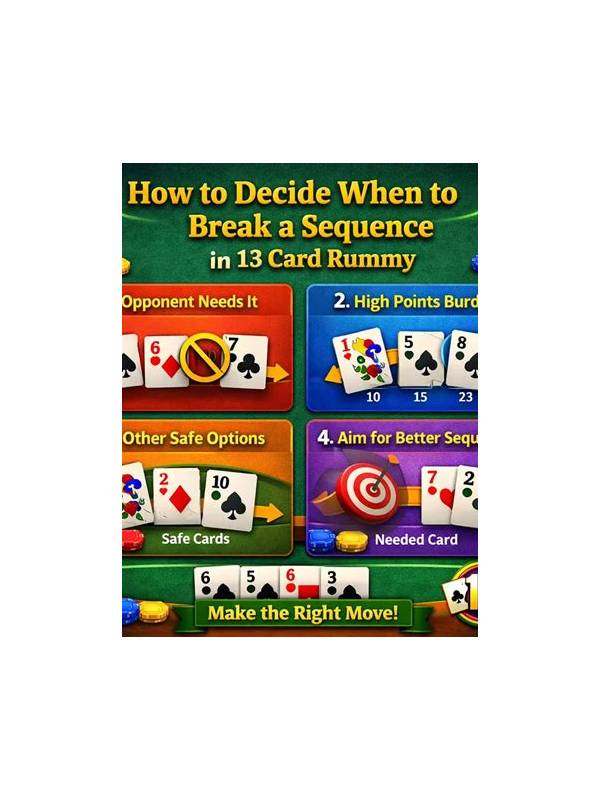
A completed set feels valuable because it removes uncertainty from part of the hand. Breaking it to complete a sequence can still be right, but only when the resulting structure is stronger and the remaining cards have a clear purpose. The move should be a reasoned exchange, not a reaction to a tempting connector.
The emotional difficulty of the move is part of the test. A completed group feels like progress, so a player may protect it even when it blocks the only practical route. The opposite error is breaking certainty merely to avoid feeling stuck. Describe both structures in plain terms and compare what each still needs. That description creates distance from the attachment to the finished group.
If the rules require a particular group, verify that requirement before doing any mental simulation. Strategy begins after legality is established.
First check the rules and the definition of a valid hand. If the set is part of a required structure, breaking it may create an invalid declaration even if the new sequence looks attractive. Next identify exactly what the break produces. Does one card complete a reliable sequence, or does it merely create another pair that still needs help? A completed group should not be sacrificed for a vague improvement.
Compare the before-and-after shapes. Before breaking, you have one secure group and some remainder. After breaking, you may have a sequence plus a smaller set, or two incomplete groups. Count the new dependencies and note which cards become isolated. The change is favorable only if it reduces total uncertainty or materially improves your route to a valid finish.
Timing matters. Early in a hand, preserving a complete set may be sensible while you gather information. Late in a hand, a concrete sequence completion may justify the risk if it shortens the path to declaration. A visible discard that supplies the final link is stronger evidence than a hope that the next draw will cooperate.
Use a one-turn rule when unsure: hold the set through one more observation unless the sequence completion is immediate and legal. Then reassess with fresh evidence. If breaking the set still leaves no backup, keep the certainty. Rummy rewards flexible thinking, but certainty is an asset too, and it should be exchanged only for a clearly superior structure.
Related Post
Rummy Comparison: Open-Ended Runs Versus Inside Gaps
Open-ended runs offer more immediate card options, while inside gaps can be valuable when the [...]
Rummy Comparison: Result Quality and Decision Quality
Separating the quality of a decision from the result of a hand makes rummy review [...]