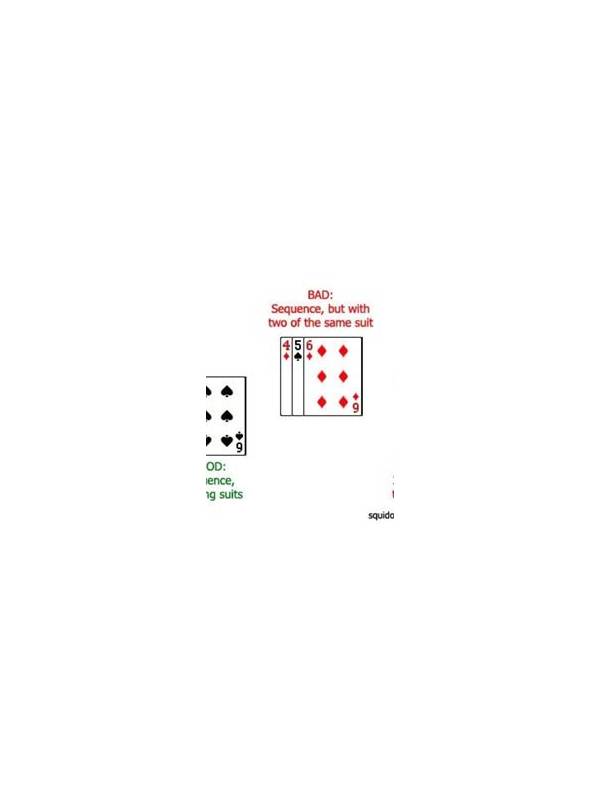
Rummy Comparison: Middle Cards Versus Edge Cards
When comparing cards for a possible sequence, middle ranks and edge ranks behave differently. Middle cards usually have more neighboring ranks, so they can connect in two directions. Edge cards near the lowest or highest end often have fewer legal extensions. This is a useful tendency, not an automatic rule for discarding.
Consider a 6 and a 7 of the same suit. They can potentially grow downward or upward, giving the pair several routes. A 2 and a 3 may have only one natural direction in a standard sequence. That makes the middle pair more flexible when both groups are otherwise equal.
However, a connected edge pair can be stronger than an isolated middle card. A 2 and 3 already form a clear structure, while an unrelated 7 has no current job. Evaluate cards as groups, not as rank labels alone. The question is not “Is this card in the middle?” but “What credible combination can this card join right now?”
Edge cards can also be efficient when they complete a requirement. A natural A-2-3 sequence may be exactly what your hand needs, depending on the format’s treatment of aces. Read the table rules because ace behavior differs between variations. Do not discard a card that is part of a confirmed valid group simply because its rank is low.
Middle cards carry a different risk: they can be useful to several players. Releasing a connected middle card may provide an opponent with an easy extension. Again, this is not proof that the discard is unsafe, but it is a reason to compare an equally weak alternative. Your own hand value remains the first priority.
Use the comparison during a discard review. If two ungrouped cards have similar points and neither supports a set, the edge card may be the cleaner release. If the edge card belongs to a pair and the middle card is isolated, release the isolated card instead. Structure beats rank theory.
The middle-versus-edge idea is most useful as a tie-breaker. Let confirmed groups, required sequences, points, and realistic extensions lead the decision. Use rank flexibility only after those stronger factors have been considered. Once a middle card belongs to a confirmed group, its rank flexibility matters less than the value of the remaining loose cards. A useful comparison always starts with the whole hand rather than one rank in isolation. That perspective prevents a general tendency from overriding the actual evidence in front of you.
Related Post
Rummy Tips: Compare Hand Plans by Number of Required Arrivals
Counting the arrivals each hand plan needs provides a practical way to compare progress without [...]
Rummy Set Completion: Compare Rank Groups Without Chasing Them
A focused method shows when a same-rank group is worth keeping and when it is [...]