Rummy Guide: Give Every Joker a Specific Assignment
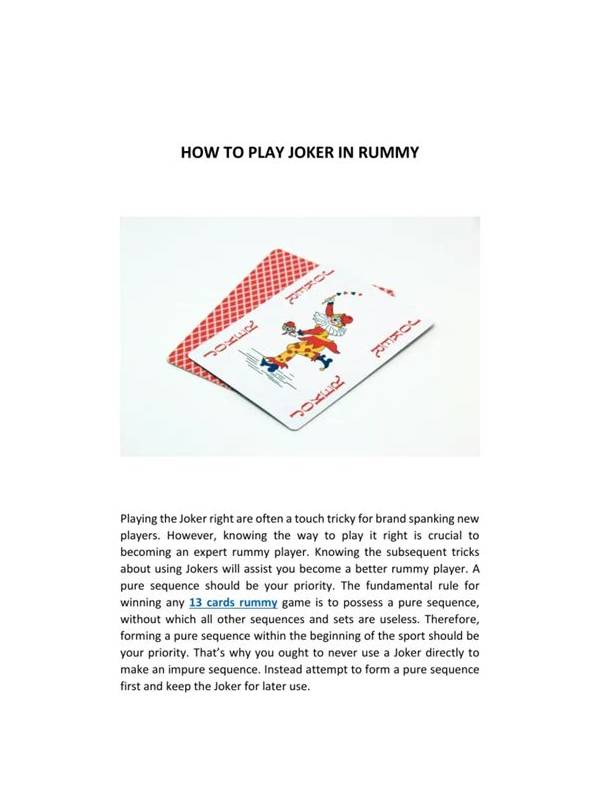
A joker is powerful because it can fill a missing role, but its value becomes clearer when you give it a specific assignment. Holding a joker as a general promise can make a hand look stronger than it is. Decide which unresolved group would benefit most, then check whether using it there leaves the rest of the hand workable.
Start with the format’s joker rules. Wild cards may have restrictions on sequences, sets, or declarations. A combination that looks complete may not qualify under the rules. Once the legal options are clear, compare the joker’s possible jobs. It may complete a natural-looking sequence, rescue a difficult set, or reduce the cost of a high singleton.
Prefer a role that is hard to replace with ordinary draws. If one group needs a narrow rank while another can be completed by several neighbors, the joker may have greater practical value in the narrow group. This is not absolute: a joker that completes a required sequence may be more important than one that merely reduces points. Consider the whole hand, not the card in isolation.
Be careful with double counting. The joker can support only one group at a time under common rules. If you imagine it completing two different routes, mark one route as the current assignment and the other as a backup. This simple distinction prevents a hand from appearing finished when it still needs another card.
Revisit the assignment after each useful draw. An ordinary card may complete the role you had reserved for the joker, freeing the joker for a more difficult group. Alternatively, new information may show that your original route is too narrow. Flexibility is valuable precisely because the assignment can change.
For practice, describe the assignment in one sentence: “This joker is protecting the group that would otherwise need the most specific help.” If you cannot complete that sentence, your hand may be using the joker emotionally rather than strategically. A specific assignment makes the card’s value visible and makes future discards easier to justify.
An assignment should also include a release condition. If an ordinary card completes the protected group, or if the route becomes too narrow after several turns, reconsider the joker. This prevents you from treating the wild card as sacred. Its purpose is to improve the final arrangement, and that purpose can require moving it. Write the assignment beside the hand during practice. A visible note makes it easier to notice when the card has already completed its most difficult job.
Related Post

Rummy FAQ: What Is the Cost of Keeping a Second Joker?
A second joker can add flexibility, but its value should be weighed against space, structure, [...]
Rummy Comparison: Visible Evidence Versus Hidden Cards
Comparing visible discards with unknown cards helps players choose plans that match the evidence. [...]