Rummy Opponent Signals: What a Discard Can and Cannot Show
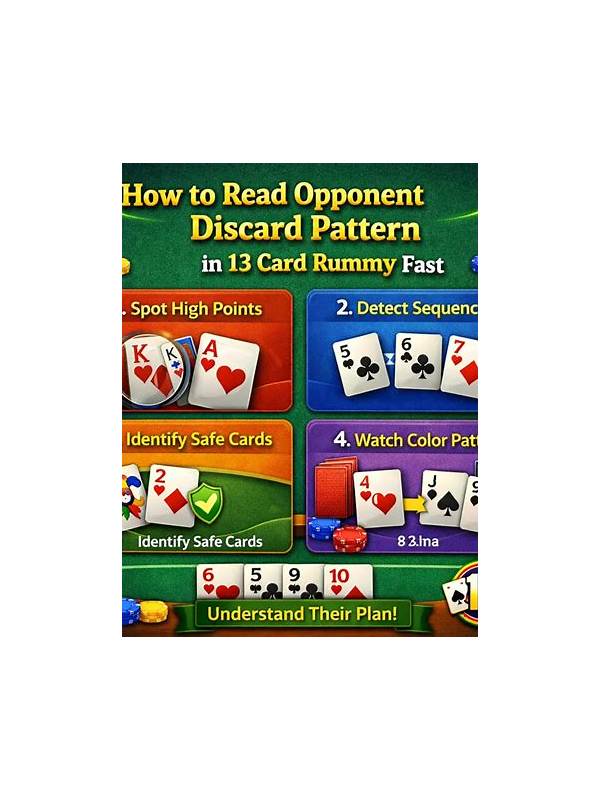
A discard can reveal that a player did not want a card at one moment. It cannot reveal their entire hand or guarantee that the card is safe for you to release. Good observation respects that limit. The aim is to improve your own comparison, not to invent certainty about another player’s hidden cards.
Begin with the direct signal. A card discarded after being drawn may be different from a card released from an old group, but you may not know which situation occurred. A repeated pattern is more informative than one event. Even then, the signal is conditional on the player’s format knowledge, timing pressure, and possible need to disguise a plan.
Use the observation to adjust, not dictate, your move. If a player repeatedly ignores cards of one suit, you might be less eager to give them another card from that suit, provided your own hand can afford the choice. If you need that card to complete a required group, your own legality remains more important than a speculative read.
Avoid reverse certainty. A card not discarded is not proof that it is wanted, and a card taken from the open pile is not proof of a complete plan. Several players may hold the same rank, and the deck may contain multiple copies. Always return to your hand, the actual rules, and the available alternatives.
For review, write the observation and the conclusion separately. “Player took a nine” is a fact; “player is building nines” is a hypothesis. This separation helps you learn from public information without overfitting a single hand. Observation is strongest when it remains modest, testable, and subordinate to sound personal decisions. A useful safeguard is to make your own move before writing a detailed theory about anyone else. First protect your legal structure and reduce your own exposure. Then use the public signal as a tie-breaker between reasonable options. This order prevents an interesting read from pulling you away from a hand that already has a clearer, more reliable improvement available. A single signal may still be useful as a prompt to check your discard, but it should not override a clear need in your own hand. Keep the confidence level low until several observations point in the same direction. This protects against reading intention into ordinary variance. Keeping this discipline also makes table interaction calmer. You can observe another player without staring at every action or reacting to imagined threats. Attention returns to your own hand, where the evidence is strongest and the responsibility for the decision is clear.
Related Post

Mastering the Art of Yono Ahe Satta Matka A Comprehensive Guide
Mastering the Art of Yono Ahe Satta Matka A Comprehensive Guide Yono Ahe Satta Matka, [...]
Rummy Tips: Use a Soft Commitment for Uncertain Cards
A soft commitment lets you support a promising rummy idea while retaining a clear way [...]