Rummy Comparison: Open Melds Versus Hidden Possibilities
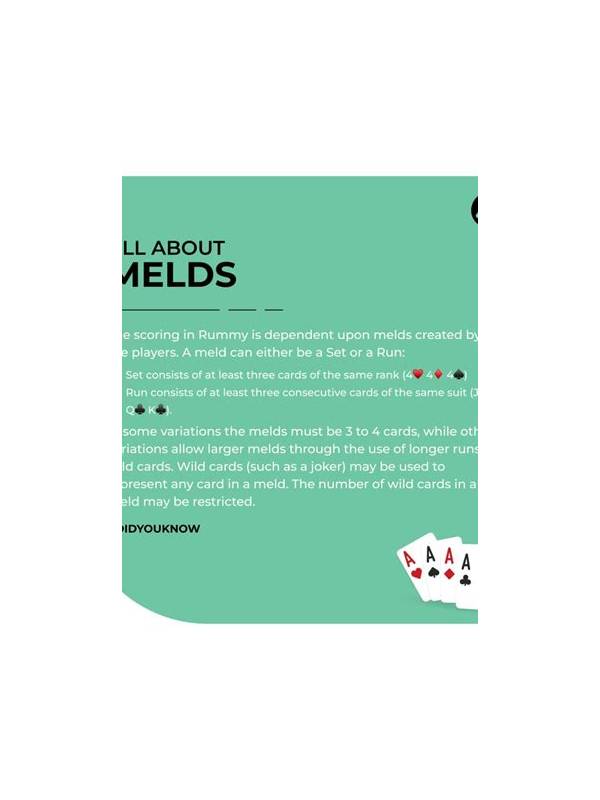
An open meld gives certainty: you know that part of the hand is complete, and your remaining cards are easier to assess. A hidden possibility gives flexibility: it may still become a sequence, set, or replacement for another group. Neither is automatically better. The choice depends on rules, remaining cards, and how much support the hidden plan actually has.
Open groups reduce mental load. Once a valid meld is set aside, you are less likely to count one card in two competing plans. This helps beginners and matters during fast turns. An exposed group can make the next discard clearer because you are evaluating a smaller unresolved hand.
The weakness is commitment. Opening a weak group too early may lock you into a shape that would have improved if one card had remained flexible. Before committing, identify what the meld consumes. Does it require a high-point card? Does it separate two cooperating cards? Does it leave several unrelated cards behind?
Hidden possibilities are useful when they have several routes. A pair that can become a set or join either of two sequences has genuine flexibility. A single card that fits one exact missing rank is narrow. Ask how many distinct draws improve the plan and whether those draws remain plausible at this stage.
Information also has a cost. An open meld can show others what you no longer need, while a concealed plan is harder to read. Do not overvalue secrecy, though. Hiding a weak plan rarely creates an advantage. If exposing a valid group substantially lowers risk, the information cost may be small.
Use a simple rule: commit when the group is strong, the remainder improves, and alternatives are narrow. Keep a possibility hidden when it has several realistic routes and time remains. This comparison prevents “hidden” from becoming a synonym for “hopeful,” and makes the whole hand—not the most attractive group—the basis of the decision. +Review open and hidden choices by examining the remainder on paper. This makes it harder for the most attractive group to dominate your judgment. If the remainder contains multiple loose cards, the commitment was expensive even if the meld was valid. If the remainder is coherent, the visible commitment probably earned its information cost.
Related Post
Rummy Tips: Count Open Ends Before Chasing a Run
Counting the open ends of a possible run gives a practical test for whether a [...]
Rummy How-To: Create a Last-Three-Turn Routine
A final-three-turn routine helps rummy players verify legality, reduce risk, and avoid rushed declarations. [...]