Rummy FAQ: When Should You Break a Nearly Complete Sequence?
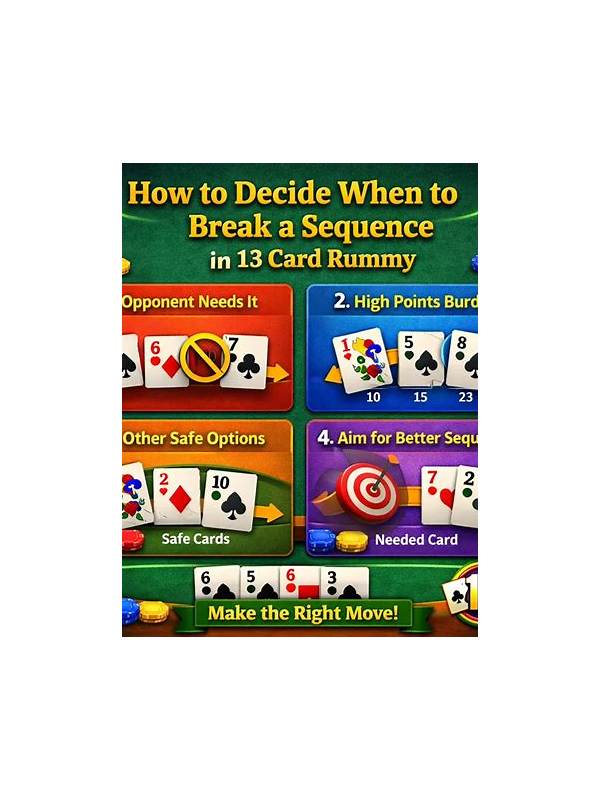
A nearly complete sequence feels valuable because its shape is easy to see. Two connected cards can look like progress, especially when only one card appears to be missing. Yet keeping that pair is not automatically correct. The right question is whether the missing card is realistically available and whether the pair is stronger than the alternatives in your hand.
Begin by checking the rule requirement. In many Indian rummy formats, a valid declaration needs at least one pure sequence, but exact requirements and card counts can vary by game. A pair that may eventually help a pure sequence should be treated differently from a pair that can only become an impure sequence using a joker. Confirm the table rules before judging its value.
Next, count practical improvements rather than imagining every theoretical one. If a five and six are together, several nearby cards might help, but some may already be visible or may create a weaker arrangement than another route. A pair surrounded by flexible cards deserves more time than a pair whose missing connection is very narrow. The important measure is not how attractive the pair looks; it is how many useful outcomes remain.
Consider the cost of waiting. Holding the pair may force you to keep a high-point card, abandon a promising group, or pass up a card that completes a required pure sequence. A hand should be evaluated as a whole. If breaking the pair creates two realistic routes while keeping it preserves only one uncertain route, the break may be the more disciplined choice.
Timing also matters. Early in a hand, preserving a speculative connector can be reasonable because several draws remain. Later, the same connector may need a clear justification. As the hand develops, move from possibility-based decisions toward completion-based decisions. A nearly complete sequence that has not improved after several turns should be reassessed rather than protected out of habit.
It is also useful to separate breaking from abandoning. You can release one card from a pair while preserving another connection elsewhere. That small adjustment may lower risk without destroying every route you have built. Look for partial repairs before making an all-or-nothing choice.
Breaking a sequence does not mean the original choice was foolish. It means new information changed the balance. Make the change deliberately: identify the card being released, name the stronger structure it supports, and verify that your remaining groups still meet the rules. This short explanation prevents an emotional discard and turns a difficult moment into a clear hand-management decision.
Related Post
Rummy Connection Problems: A Calm Recovery Checklist
A practical checklist helps online rummy players protect a hand when a connection becomes unstable. [...]
Rummy How-To: Make a Small Evidence Ladder
An evidence ladder separates facts, reasonable inferences, and guesses so table information stays in proportion. [...]