Rummy Guide: Separate a Legal Group From a Useful Group
A legal group is not automatically a useful group. Validity answers whether the cards meet the table’s rules. Usefulness asks whether keeping them together improves the rest of the hand. Making both checks prevents a neat arrangement from hiding a poor plan.
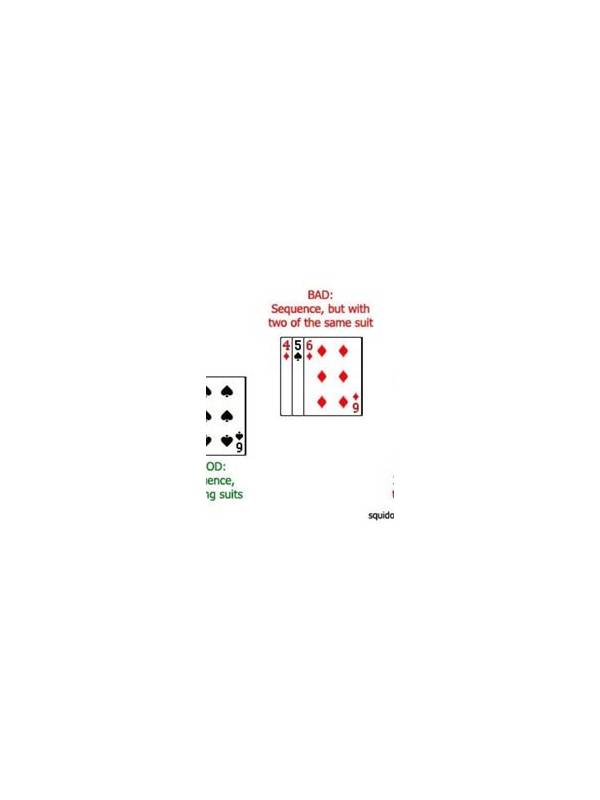
Start with the legal test. For a run, verify suit, rank order, length, and any rule about ace placement or wild cards. For a set, verify rank, suit restrictions, and the maximum size. If a joker substitutes for a card, identify exactly what it represents. Never rely on the visual grouping alone, especially after moving between variants.
Then apply the structural test. Does the group satisfy a required condition? Does it protect low-point cards? Does it leave enough space for another confirmed or flexible group? A legal group that consumes a joker for a minor improvement may be weaker than a slightly less tidy arrangement that preserves two routes.
Consider future compatibility. If keeping the group together makes every remaining card isolated, it may be worth reassessing. Conversely, breaking a legal group can be expensive if it removes your only confirmed sequence. Compare the whole hand rather than judging one group by itself. The best arrangement is often the one that leaves the most realistic ways to finish.
Use a two-label review during practice: write “legal” beside groups that pass the rules, and “useful” beside groups that also improve the hand’s direction. Some groups will receive both labels; others may receive only the first. This makes the distinction concrete and helps explain why a valid group might be rearranged later.
Before declaring, perform the legal test again even if the structure has looked correct for several turns. Check that no last-minute rearrangement created a gap or invalid substitution. Then perform the usefulness test by counting unresolved cards and confirming the scoring consequence. Accuracy first, efficiency second, and confidence only after both checks are complete.
This distinction is useful when reviewing a loss. A legal but inefficient group may explain why the hand became difficult, while an illegal group explains why the declaration failed. Those are different lessons and need different corrections. Keep a rule reference nearby during practice, but use the same final verification routine you would use at a real table so the habit transfers cleanly.
Related Post

Rummy Connection Distance: Measuring How Much a Card Needs
Counting the distance between cards offers a practical way to compare promising and speculative combinations. [...]
Rummy FAQ: Why Does a Discard Need a Reason?
Giving every discard a short reason makes rummy decisions easier to review and improve. [...]