Rummy Guide: Distinguish a Near Group From a Real Group
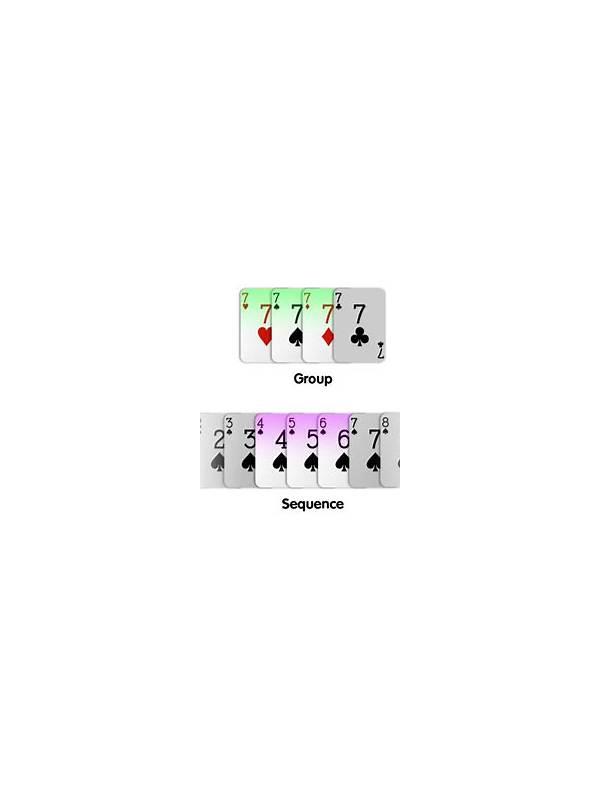
Cards that look related are not necessarily a group. A real group has a legal structure under the format’s rules and can be used in a declaration. A near group is only a possibility. Treating the two as equal is a common reason players carry too many uncertain cards.
Test a suspected sequence by checking three properties: same suit where required, consecutive rank order, and the minimum length for the format. A pair of neighboring cards may be promising, but it is still incomplete. Test a suspected set by checking matching ranks, different suits where required, and any limit on duplicate suits. Rules vary, so verify the current table rules instead of relying on a remembered variation.
After the legal test, measure the group’s completion cost. A two-card near sequence with two possible connectors may be more practical than a three-card pattern needing one exact card. However, a near group with many theoretical completions can still be poor if those cards are already unavailable or would damage another required group.
Use a simple status system: complete, one card away, two cards away, or speculative. “Speculative” applies when the cards share only a broad feature, such as the same suit or rank. This label prevents the eye from giving a weak pattern too much importance.
Overlap deserves extra attention. A card may appear in two near groups, but it cannot always serve both in the final arrangement. Before protecting an overlapping card, sketch the complete groups each route would require. If both routes depend on the same card, the hand has less flexibility than it appears to have.
Jokers and wild cards can change the test, but they should not hide an invalid structure. Ask what the group would look like after substitution and whether the result remains legal. A joker that fills a missing card is useful; a joker used to excuse an otherwise impossible arrangement may create a false sense of progress.
During play, reclassify groups after each meaningful draw. A speculative pair can become a strong sequence start, while a one-card-away group can become unattractive if the needed card is no longer worth waiting for. The goal is to see structure clearly, so your hand is guided by legal routes rather than by visual resemblance.
If you are unsure, arrange the cards on a table or use a private practice display that shows suits and ranks clearly. Physical or visual separation makes it easier to notice a missing rank, an illegal duplicate, or a card that has been counted twice.
Related Post
Rummy FAQ: Why Do Unfinished Groups Compete?
Unfinished groups compete when they depend on overlapping cards, shared hand space, or the same [...]
Rummy Strategy: Compare Discards by Information Cost
A discard can change what opponents learn, so card value should include information as well [...]