Rummy FAQ: What Is a Dead-End Group?
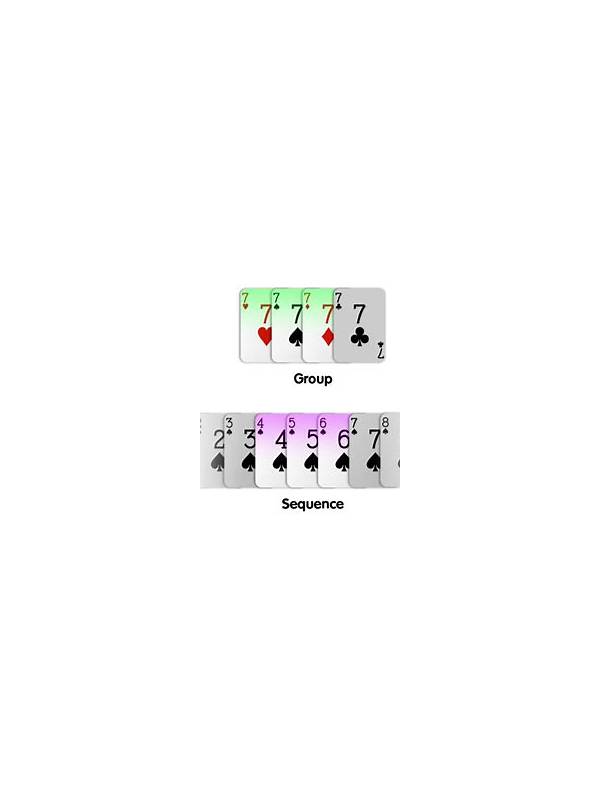
A dead-end group is a pair or partial run that consumes attention without offering enough practical ways to become a legal completed group. It is not necessarily a bad group at the moment you notice it. Its value depends on the available cards, the remaining turns, the rules, and the alternatives in your hand.
Consider two cards separated by a large gap, or a pair that can be extended only by one specific missing card. Such a group may remain attractive because it is visually organized. However, if several other cards would complete broader routes, the narrow group may be tying up useful flexibility. The problem is not that the group is incomplete; all groups begin incomplete. The problem is that its future is too constrained.
To test a group, ask three questions. How many distinct cards could improve it? How many turns can I reasonably wait? What do I give up by holding it? A group with several plausible improvements may deserve protection. A group with one unlikely improvement should be compared with the value of reducing deadwood now.
Watch for the sunk-cost effect. A player may keep a group because it has survived several turns, even though new information has made it weaker. The number of turns already invested does not increase the chance that the needed card will appear. Reassess the group whenever the discard pile or your own draw changes the available routes.
Dead-end does not mean discard immediately. A high-value card might still be useful as a temporary blocker, and a pair can sometimes be a safe waiting structure. The label simply tells you to demand a reason for continued investment. If the reason is only “I have held it for a long time,” that is not enough.
When reviewing a hand, mark one group as promising, one as uncertain, and one as costly if the hand allows. This simple classification prevents every organized pair from receiving equal protection. It also makes later decisions clearer: complete the promising route, test the uncertain route briefly, and release the costly route when a safer improvement appears.
Related Post
Rummy Sets Versus Sequences: A Decision Guide for Beginners
Compare sets and sequences by their role in a valid hand, not by which group [...]
Rummy Rules for Sharing a Physical Deck at Home
Agreeing on handling, scoring, and turn procedures makes a casual home rummy game smoother. [...]