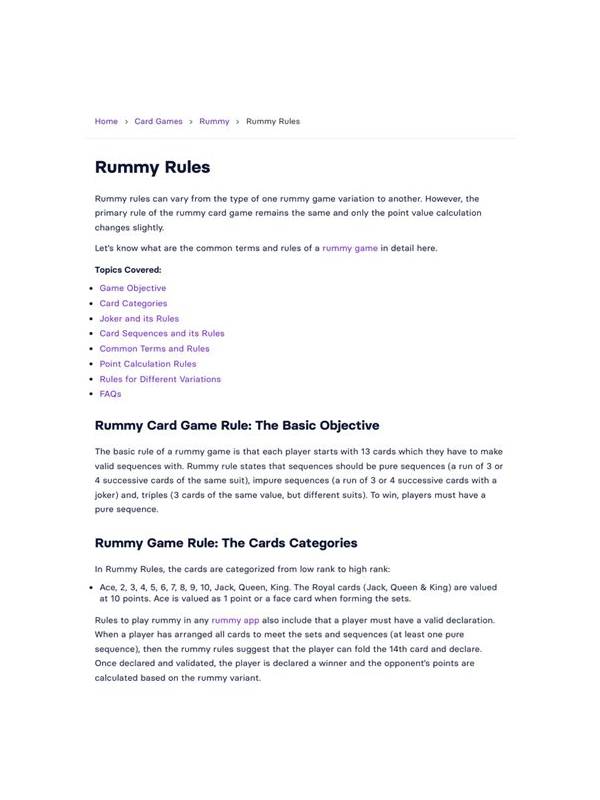
Rummy FAQ: Why Can a Useful Card Still Be a Bad Keep?

A card can be technically useful without being the best card to keep. The key question is not whether it has any connection, but whether that connection is stronger than the alternatives available in the current hand.
Imagine a middle card that can join one narrow sequence. It may look attractive because it has a visible route. However, another card in your hand may support two different sequences, protect a completed group, or offer a safer discard later. Keeping the first card simply because it is not isolated can hide an opportunity cost.
Evaluate the card in context. How many cards improve it? How many different groups could those improvements support? Does it compete with a confirmed sequence for the same connecting card? A pair that requires one exact rank may be less practical than a singleton that can join several routes, even though the pair appears more developed.
Point exposure matters too. If the useful card is high-value and the improvement route is uncertain, its downside can dominate. A low-value card with a narrow route may be acceptable early, while a high-value card with the same route may need a firm deadline. Your decision should reflect both potential progress and the cost of being wrong.
Finally, consider what the card tells you about your next discard. Some keeps leave several reasonable releases; others force you to break a useful connection whenever the next draw disappoints. A card that preserves decision quality can be better than one that promises a slightly faster finish.
The practical test is simple: name the card’s best route, its strongest alternative, and the cost of waiting. If the route still wins after that comparison, keep it deliberately. If not, release it without regret. “Useful” is a description of possibility; “good keep” is a comparison between possibilities, timing, and risk.
This is why reviewing the whole hand matters more than judging a card in isolation. A card can improve one group while making another group impossible, or it can preserve a useful discard even when it does not advance immediately. When two options seem close, prefer the one that leaves you with more ways to recover from the next ordinary card. Recovery value is easy to overlook because it does not look like progress, but it often determines whether a hand remains manageable. That recovery question is especially valuable near the end, when one attractive possibility can distract from the need to keep every remaining card legally useful.
Related Post
Rummy How-To: Use a Simple Hand Strength Scale
A five-level hand scale helps players make consistent choices as a rummy round changes. [...]
Rummy Turn Notes: A Simple Way to Track Useful Information
Learn how brief turn notes can improve memory and decision quality during a rummy hand. [...]