Rummy FAQ: Can a Set and Sequence Share One Card?
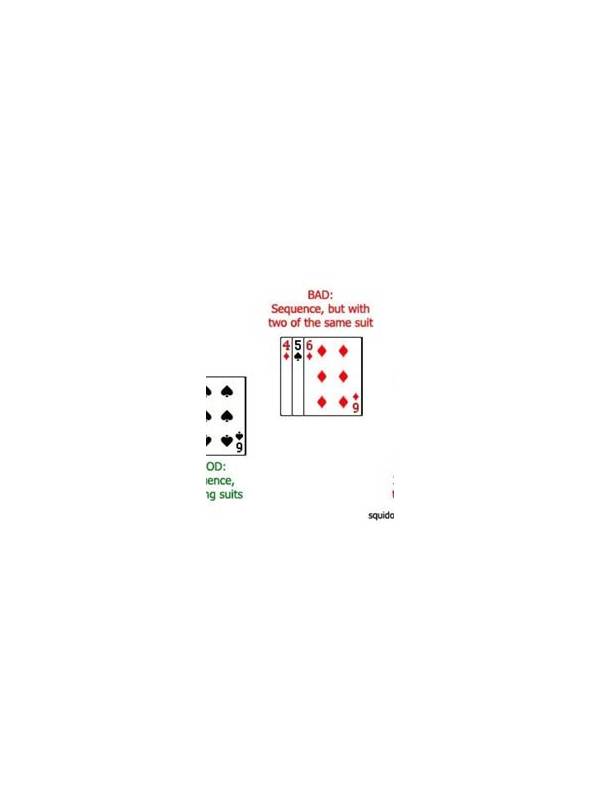
A common rummy question is whether one card may be counted in a set and a sequence at the same time. In standard Indian rummy-style play, the answer is no: each card in the hand must belong to one grouping only. A card cannot be used twice merely because it appears to fit both arrangements.
Consider a hand containing the seven, eight, and nine of hearts, plus two sevens of different suits. The seven of hearts belongs naturally to the heart sequence. It cannot also be counted as the third card needed for a seven set. To make both groups valid, you need another seven for the set or another card that changes the sequence arrangement.
Why does this rule matter? During a quick rearrangement, a player may mentally count the same card twice and believe the hand is complete. The interface may let you move cards into several visual positions, but a visual layout is not necessarily a legal declaration. Before submitting, trace every card from left to right and assign it to one group.
The same caution applies when jokers are used. A joker may substitute according to the format’s rules, but it still occupies one card position in one meld. It does not create an extra physical card that can be counted elsewhere. Read the table’s specific rules if wild cards or special sequences are involved.
A useful checking method is to label each card temporarily. Write S for sequence, T for set, and U for unused beside the cards in a practice hand. If a card receives two labels, the arrangement needs revision. Then confirm that any required pure or natural sequence is present and that the number of groups satisfies the format.
Rules can vary between games, so the help screen or published rules for the particular table take priority. Still, the one-card, one-group principle is a reliable starting point. Treating each card as a single resource makes declarations clearer and exposes weak plans before they become costly mistakes.
This check is also helpful when a hand contains overlapping runs. A card may appear to bridge two sequences, but choosing one sequence means the neighboring cards must still form a complete group elsewhere. Move the candidate card mentally from one arrangement to the other and inspect what remains. If either arrangement leaves an ungrouped card or violates the required sequence type, it is not a complete solution. Practicing this substitution test makes real-time declarations less confusing.
Related Post
Rummy Comparison: Counting Groups or Counting Unresolved Needs
Two ways of reading a hand can lead to different priorities, so learn when each [...]
Rummy Tips: Read a Weak Discard as a Planning Signal
A discard that looks weak can reveal a change in your own plan before it [...]